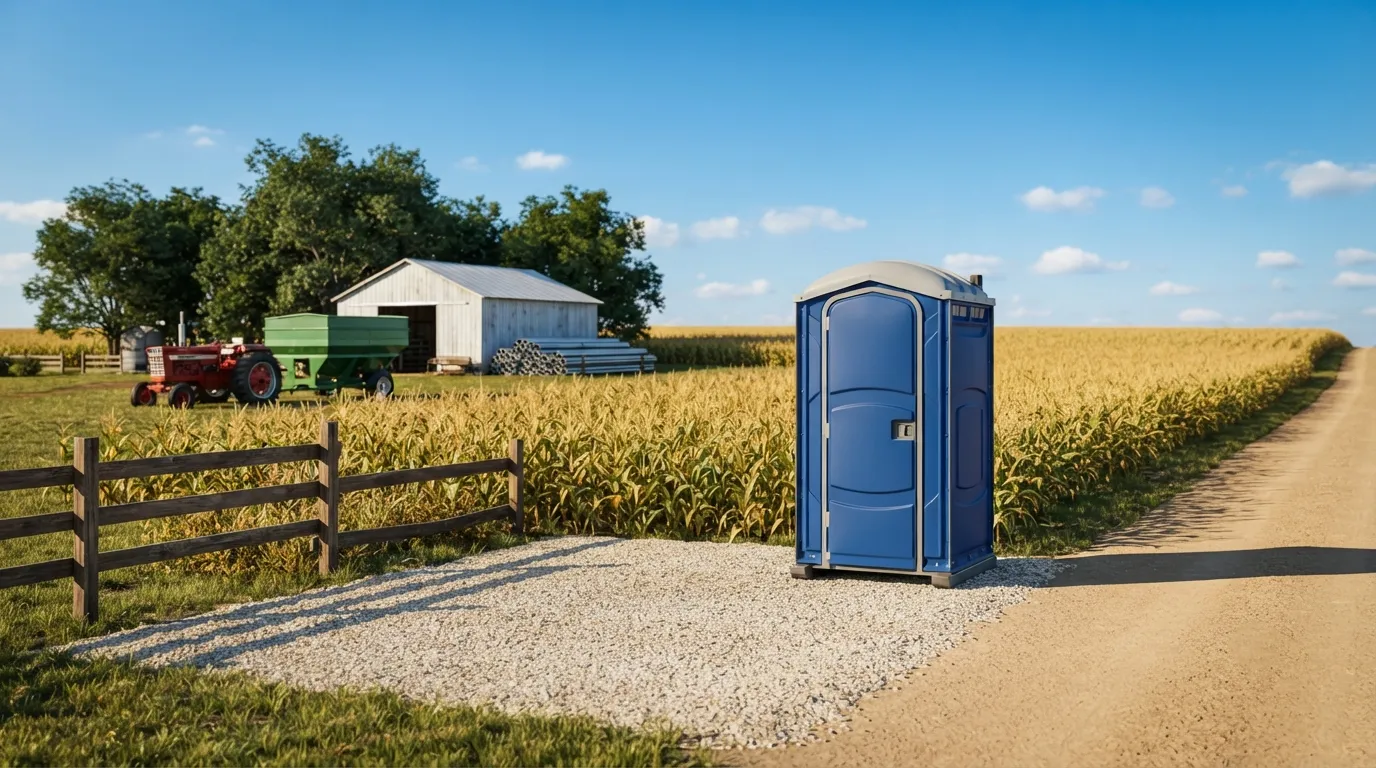
Farm and agricultural restrooms in Kenosha run on a simple rule: one facility for every 20 hand-labor workers, placed within a quarter mile walk, per OSHA 1928.110. Kenosha Porta Pros sets up standard units at farms, orchards and seasonal operations across the county, with weekly service built around harvest schedules.
Start with the headcount doing hand labor, because OSHA 1928.110 sets the baseline at one toilet and handwashing facility per 20 employees, reachable within a quarter mile of where people are working. That is different from a construction crew, where OSHA portable toilet requirements follow the 1926.51(c) ratio instead. A 15-person crew picking berries on one side of a Kenosha farm still needs a unit close enough to walk to inside that quarter mile, not parked at the barn a half mile off. If your operation spreads across multiple fields, you will likely need more than one cluster rather than one big bank of units at a central yard. We size this out for free during a request a quote call, and we walk the layout with you the same way we would for construction site services, just with the field-labor ratio instead of the trade-crew one. Potable water matters here too. OSHA 1926.51(a)(1) requires an adequate supply of potable water at any place of employment, and on a farm that often means pairing a standard porta potty rental with a handwashing station rental rather than assuming a hose bib counts. If your labor pool grows during harvest and shrinks after, a monthly porta potty rental flexes better than a string of short bookings, and Kenosha farms tend to book that way from planting through picking.
Handwashing on a farm is not optional and it is not satisfied by sanitizer alone. 29 CFR 1910.141(d)(2) requires soap and towels or a hand drying device at any washing facility, and a hand sanitizer station rental does not replace that if it is the only thing on site. We pair every restroom cluster with a proper wash station, either a standalone unit or a portable sink rental plumbed with its own tank. If your crew handles pesticides, herbicides or treated seed, OSHA 1926.51(f)(1) requires washing facilities specifically for workers applying paints, coatings, herbicides or insecticides, so that station needs to sit right at the field edge, not back at the equipment shed. Kenosha operations running spray crews should plan for that placement before the season starts, not after an inspection flags it. Check the full handwashing station requirements if you are staffing up for the first time. Water access on working farmland is often the hardest part, since the units need refilling and the trucks need a way in. We handle that as part of routine service, same as we do for septic pumping service calls out to rural properties around Kenosha.
Yes, and Kenosha winters are the main reason farm accounts plan ahead instead of calling in December. A standard unit holds 60 to 70 gallons in its tank, and in freezing weather that tank needs additive and more frequent service to keep it from freezing solid, which we cover in our porta potty in winter guide. Remote field access is the other issue. If a unit sits down a farm lane with no gravel pad, our truck still needs a reasonably clear path in, and that is worth flagging when you book so we do not show up and have to reroute. Farms near Pleasant Prairie, about 4.9 miles south of central Kenosha, and Somers, about 5.0 miles north, are common stops on our regular route, so service timing tends to be tighter there than for a one-off site further out. If your farm also runs a market stand, agritourism weekend or corn maze, that is closer to event restroom rental territory and we can quote it separately from the everyday field units. For septic-served farmhouses on the same property, a 1,000 gallon tank is typically pumped every 3 to 5 years depending on household size, and we run that alongside the portable restroom service so you are not coordinating two vendors. See how often to pump a septic tank for the detail.
| unit | duration | typical price |
|---|---|---|
| standard | week | $200 |
| standard | month | $200 |
| service_fee | month | $150 |
Most farms book standard units on a weekly or monthly basis, and pricing sits in the table above. Exact cost depends on unit count, service frequency and distance from our route. See porta potty rental cost for a full breakdown, or request a quote with your headcount and site layout.
Yes, if you want to meet 29 CFR 1910.141(d)(2), which requires soap and towels or a drying device, not sanitizer alone. Most farms pair one wash station per restroom cluster. See handwashing station rental for options and setup.
OSHA 1928.110 sets a quarter mile walk as the outer limit for agricultural field sanitation. Beyond that, add another cluster rather than stretching the walk. We help plan spacing during your request a quote call.
Yes. We run weekly service through Kenosha farm accounts from planting through harvest, adjusting frequency as crew size changes. A monthly porta potty rental usually works out simpler than rebooking week to week.
Units need antifreeze additive and closer-spaced service once temperatures drop, covered in our porta potty in winter guide. Remote farm lanes also need a clear path for our truck to reach the unit reliably.
Yes. Kenosha Porta Pros delivers farm and agricultural restrooms across Kenosha and the surrounding metro, with same-day and next-day drop-off available on most orders.
Pricing depends on the unit and how long you need it. See our cost breakdown and request a free quote for an exact figure.
Standard rentals include scheduled service — a pump-out, a clean, a restock and fresh deodorizer. Busy or hot-weather sites can be serviced more often.
Call now or request a free quote — clean units, on-time delivery, transparent pricing.